Tethered caps: the EU rule and what it means for production
Since July 2024, plastic caps on drinks containers up to 3 litres sold in the EU must stay attached. What the rule covers and how to produce tethered caps.
(updated )
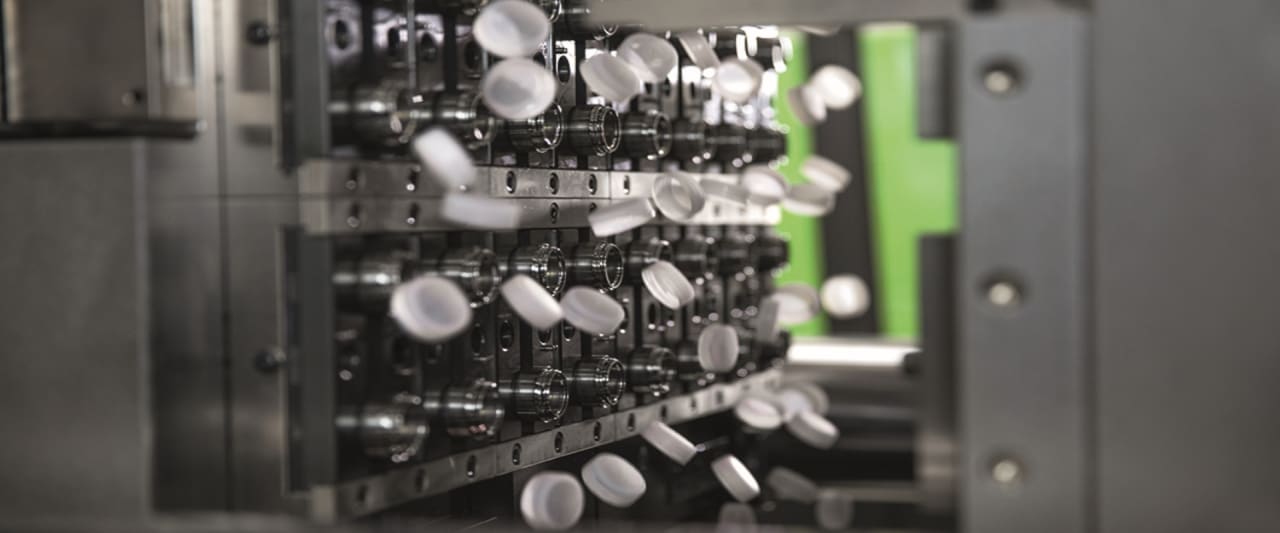
The short answer: since 3 July 2024, single-use plastic drinks containers of up to 3 litres may only be sold in the European Union if their plastic caps and lids stay attached to the container while it’s in use. The rule comes from the EU Single-Use Plastics Directive (2019/904, Article 6). Caps for products sold in the EU must meet it wherever they are made, and some brands use tethered caps in other markets too, so they can run one design worldwide. Most producers meet it with a band that holds the cap after opening, which usually means new or modified moulds and a faster, higher-pressure injection process.
What the rule covers
- Covered: single-use drinks containers of up to 3 litres with plastic caps or lids, including plastic bottles and composite drinks packaging such as cartons.
- Not covered: glass or metal drinks containers with plastic caps or lids, and containers for liquid food for special medical purposes.
- Why: loose caps and lids are among the single-use plastic items most often found as litter on EU beaches. A cap that stays on the bottle is collected and recycled with it.
- Testing: the European standard EN 17665 sets out how to test that a cap stays attached.
What a tethered cap has to do
Besides staying attached, a tethered cap still has to work like any other closure:
- fit existing preforms, neck finishes and threads, or the new neck the brand moves to
- open and close easily for the consumer, and stay out of the way when drinking
- run on existing filling and capping lines
- keep its tamper evidence
- be made at the same output as before, ideally from the same material
How tethered caps are produced
There are two production approaches:
- Slitting: the cap is moulded as before, and the band is cut free in a separate step afterwards. Existing moulds can often be kept, but it adds a process step and limits the cap design.
- Moulding the connection in: the band and its bridges to the cap are moulded in one shot. This needs new moulds, but there is no extra step, the design is freer and the connection is stronger.
And two common designs:
- Lasso: a band around the neck holds the cap on a strap once opened. It is the easier change: existing moulds can often be adapted.
- Hinge: the cap stays joined to the neck by a hinge and can often be clicked back out of the way while drinking. It usually needs new moulds, and sometimes changes on the filling line and cap feeding.
Many producers started with lasso designs because they were quicker to bring in. Some use the change to move to lighter neck finishes at the same time, which can save material and cycle time.
What it means for the injection moulding machine
The thin bridges and the band change how the mould fills. Tethered caps typically need:
- higher injection speeds
- higher injection pressure
- higher pressure inside the cavity, because there are more and narrower flow paths to fill
The clamping force needed usually doesn’t go up, especially when the move to tethered caps comes with a lighter neck finish.
Machines for caps and closures from GreenTech
GreenTech supplies, installs and services ENGEL injection moulding machines. ENGEL’s e-cap is an all-electric machine built for high-output caps and closures production, with the injection speed and precision tethered designs need. See packaging for more, or contact us to talk about your caps and closures production.