Maximize ROI: ENGELs Integrated Systems Drive Efficiency
Maximize floor space efficiency with ENGELs integrated robotics for automotive lighting production.
Space Saving Champion: How ENGEL Boosts Efficiency with Integrated System Solutions
Vehicle lighting systems evolve in increasingly short cycles, and so must their manufacturing processes. As components grow more complex, manufacturers face mounting pressure to improve efficiency and cost-effectiveness. For one European Tier 1 supplier of automotive lighting systems, productivity per square meter has become a critical success factor. Their solution? ENGEL easix multi-axis robots that keep injection molding cells remarkably compact.
This innovative approach is transforming how they produce exterior lighting systems for passenger cars—from lenses and housings to panels and reflectors—that leave the factory as fully assembled, ready-to-install components.
The Growing Complexity of Automotive Lighting
“The market for automotive lighting systems continues to diversify,” explains the facility manager. “The demands placed on our injection-molded products are constantly increasing.”
Several developments are driving this trend:
- Innovative technologies like anti-fog coating are becoming more prevalent
- New functions such as bending light require additional electronics
- Automotive manufacturers increasingly use lighting as a distinctive design element
Working closely with customers, this processor develops customized lighting solutions across the full spectrum of technologies—from halogen and Xenon to LED and laser light systems.
Narrower by One and a Half Meters
To prevent rising production and assembly costs from impacting efficiency or unit costs, the company continuously adapts its manufacturing strategy and invests in process optimization. Two critical approaches have emerged:
- Process integration
- Comprehensive automation
“Fully automated two- and three-component injection molding processes are our standard today,” notes the manager. This approach reduces work steps and increases efficiency, despite growing product complexity.
The challenge? Production cells typically expand with increased integration and automation. Since productivity per floor space directly impacts overall efficiency, this created a new challenge for their engineering partner, ENGEL.
“High reproducibility, short cycles and reliable service aren’t enough to succeed in the automotive industry,” emphasizes the manager. “We must constantly seek technologies that require less space. ENGEL supports us optimally in all these aspects.”
The solution came through close collaboration between ENGEL’s project team and the customer’s production managers. The result is a remarkably compact production cell for manufacturing headlight lenses for a current SUV model.
The key innovation: integrating the easix multi-axis robot in just two meters of movement area—saving a full meter and a half compared to previous linear robot solutions.
Precise Handling of Sensitive Parts
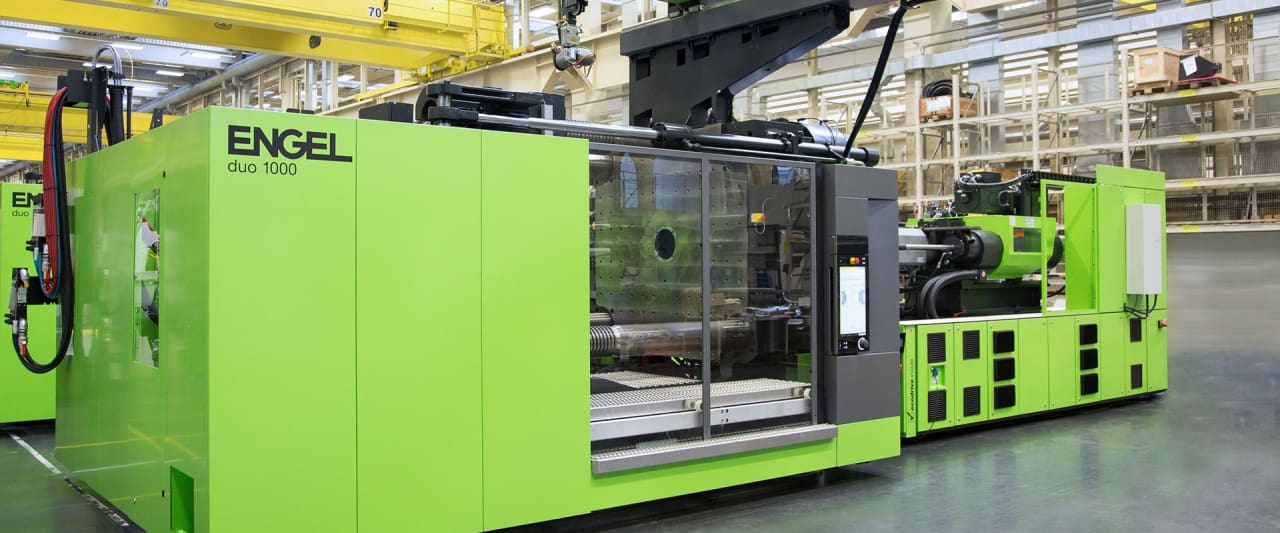
The headlight lenses consist of two different polycarbonate varieties processed simultaneously in a two-component rotary table mold. The process runs on a duo 1100 injection molding machine with 11,000 kN of clamping force:
- First step: Crystal-clear PC is processed
- Second step: Black PC is added
The easix robot’s job is to remove the finished components and place them on an encapsulated conveyor belt that functions as a clean room—critical since hardcoating immediately follows injection molding. For some headlight models, the robot also handles sprue removal.
The duo machine type dominates the plant partly due to its compact design. With a dual-platen clamping unit, these large-scale ENGEL machines have a particularly short footprint. Low-friction platen guidance on the carriage ensures optimal parallelism and high mold protection. For multi-component injection molding, several injection units can be arranged side by side or stacked to save space.
Even with a pneumatic unit attached, the easix robot arm fits comfortably under the machine’s bars and operates safely when the mold is open. “This is critical for highly sensitive optical parts,” explains the plant manager. “The mold has several core pulls and sliders, requiring extremely precise robot movement in confined spaces.”
Unified Operating Logic for Convenience and Safety
The space efficiency extends beyond the machine itself, thanks to freely definable prohibited areas and safe monitoring of robot workspaces. “With the safety gates, we can position very close to the robot,” explains Holzner from ENGEL. “Since we supply the injection molding machine and robot as an integrated system from a single source, we project from the outset including the disturbance range—it’s the only way to ensure we don’t waste any space.”
The European processor has equipped several injection molding machines with multi-axis robots, with adoption clearly trending upward. Ten years ago, their first Kuka multi-axis robot for injection molding presented significant complexity, as the robot control system was unfamiliar territory for machine operators.
To simplify multi-axis robot use in injection molding, ENGEL partnered with industrial robot manufacturers (including Kuka) to integrate complete robot control into the injection molding machine’s control system. In the ENGEL easix version, both the multi-axis robot and injection molding machine now share identical operating logic, with the entire production cell controlled via the machine’s control panel.
“Whoever can operate the injection molding machine can also operate the robot, whether it’s linear or multi-axis,” explains Holzner. “The control unit doesn’t differentiate between controlling a linear or rotary process. The additional movement instructions for the multi-axis robot integrate seamlessly with the graphical user interface.”
The facility manager confirms the benefits: “We now have just one control logic for injection molding machines, viper robots, and easix robots. We only need one technician for maintenance.” Another advantage is reduced error risk, since machine and robot share a common database.
As Holzner summarizes: “We’ve made adjustments everywhere to make the production cell even more compact,” demonstrating ENGEL’s commitment to maximizing both space efficiency and production performance.