Sustainable Lightweight Solutions: Expert Industry Insights
Discover how lightweight technology drives CO2 reduction at ENGELs global event. Learn why thermoplastics are leading the sustainability revolution in…

International Audience at ENGEL Lightweight Future Day
Lightweight technology is booming, and for good reason. It’s playing a crucial role in our collective push toward climate protection targets. The Lightweight Future Day 2021, hosted by machine manufacturer and system solutions provider ENGEL, highlighted something many of us in the industry have been tracking: lightweight is absolutely a key technology on our journey to a CO2-neutral world—and thermoplastics will be major players in this transformation.
More than 500 attendees gathered virtually to gain insights from 15 keynote presentations covering the latest developments in lightweight technology. The event attracted experts from across automotive, bicycle and motorcycle manufacturing, aviation, and sports industries, alongside researchers from leading institutes.
Despite being virtual due to the pandemic, the event created an engaging atmosphere through Q&A sessions expertly moderated by Dr. Norbert Müller from ENGEL and Dr. Bastian Brenken of Composites United. While most participants joined from Europe (particularly Germany, the UK, and Benelux countries), Christian Wolfsberger, ENGEL’s Business Development Manager for Lightweight Composites, noted that even American experts joined despite the early morning hours in their time zone.
Thermoplastic Composites Accelerate Series Production
One of the most compelling aspects of thermoplastic composites is how they’re revolutionizing high-volume production. Michael Thienel, a door solutions expert at automotive supplier Brose, shared an impressive case study:
“With an intelligent mix of materials, we have succeeded in developing an innovative door system that sets new standards in lightweight, functionality and flexible design. Compared to legacy steel-based products, we save up to five kilograms, that is, 40 percent of the weight, while maintaining the same crash safety. In addition, we have achieved a wall thickness of just 0.6 millimetres.”
Since 2018, Brose has been supplying Ford with one million door modules annually made from fiber-reinforced thermoplastics. They’re now poised to launch the next generation of door modules, which will replace additional steel elements, saving another kilogram per door while actually reducing costs.
The shift toward thermoplastic processing was echoed throughout the event. FACC, a specialist in lightweight components for aircraft, is also embracing thermoplastics—particularly for the emerging “Urban Air Mobility” market. As Rene Adam, their Director of Research & Technology, explained, this segment will require production volumes of 5,000-30,000 components yearly—significantly higher than the roughly 1,000 units per year for larger aircraft components. Traditional thermosets used in aviation simply can’t deliver the shorter cycle times needed for this scale of production.
Recycling Capability Makes Lightweight More Sustainable
The advantages of thermoplastics extend beyond production efficiency. Adam noted that thermoplastics will likely play an increasing role in traditional aircraft manufacturing as the aviation industry aims for climate neutrality by 2050:
“The production processes in the aviation industry will totally change. Hybrid casting, cold bonding and rapid forming have not yet become standard processes here. We need to significantly improve cost structures and production cycles. These are the reasons that lead us at FACC to believe that thermoplastics will be the key material for fibre composite plastics in the aviation industry looking forward.”
Recyclability was a recurring theme across presentations. Georg Käsmeier, Managing Partner at Forward Engineering, emphasized that the EU’s Green Deal is pushing to make circular economy principles standard practice:
“Now is the right time to shift from linear to circular thinking in your product development and to consider the recycling process as early as in the product design stage.”
His company’s study comparing CO2 footprints in brake pedal production revealed significant environmental benefits when using recycled thermoplastics versus primary or even bio-based materials. “We believe that thermoplastic materials have great potential in terms of sustainability. To leverage this, recycling processes now need to be established on an industrial scale. But we do see that this challenge is being addressed by industry,” Käsmeier added.
Thermoplastic Lightweight Parts in One Go
Recognizing thermoplastics’ growing importance, ENGEL has made substantial investments in technologies for processing thermoplastic composites. Paul Zwicklhuber, ENGEL’s development engineer for Composite Processing, highlighted their breakthrough:
“We are the first company in the world to be able to offer a fully integrated process that starts with a UD-tape laying cell and finishes with a fully consolidated, overmoulded thermoplastic lightweight component.”
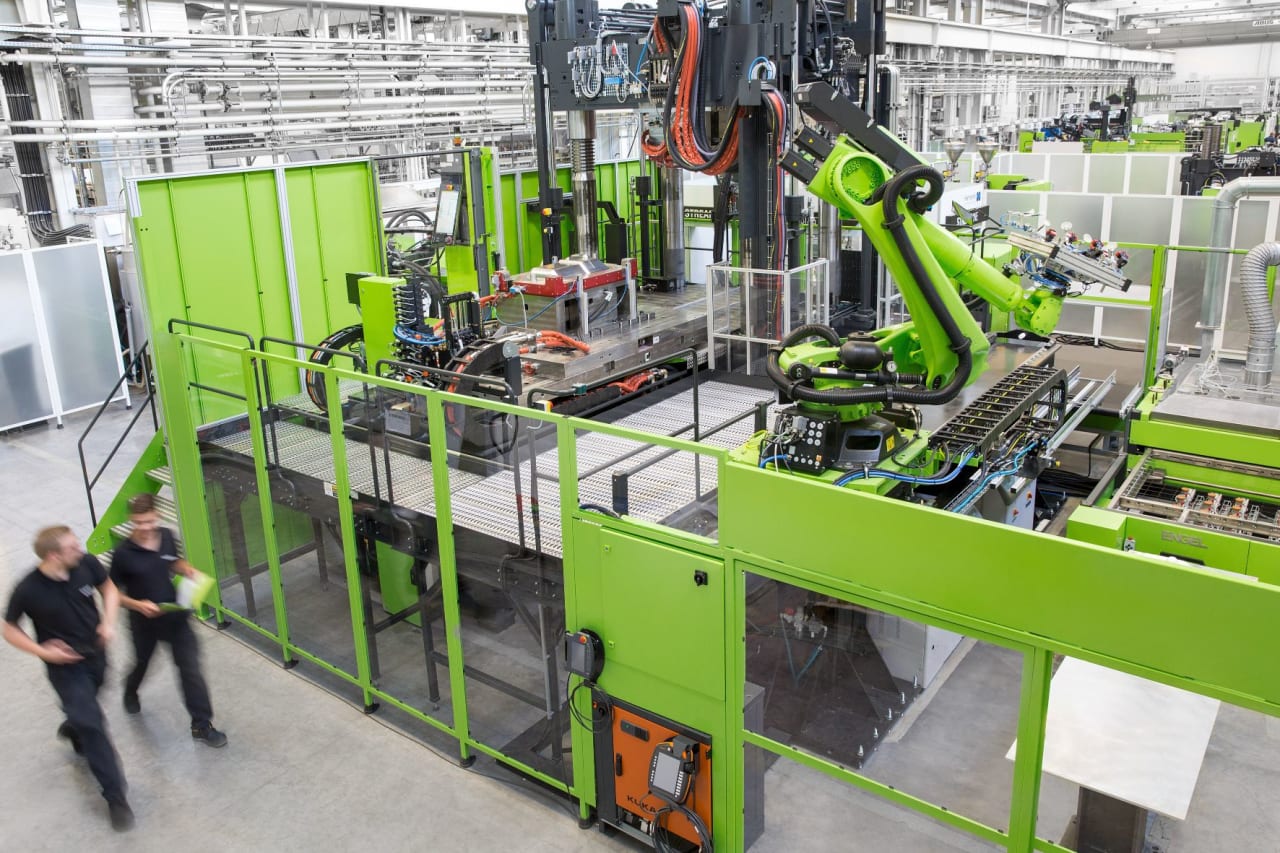
Their innovative system uses a pick-and-place approach, allowing tapes to be deposited and spot-welded at impressively quick three-to-four-second intervals. High-resolution camera technology ensures precise tape positioning—critical for stack quality. The system’s consolidation unit then processes thermoplastic tape fabrics directly within the injection molding cycle, significantly boosting efficiency for tailor-made tape solutions.
The ENGEL organomelt process forms the core of this integrated approach. It allows thermoplastic fiber composite prepregs like UD-tapes and organic sheets to be formed and functionalized in one step. Immediately after thermoforming, functional elements such as reinforcing ribs or assembly components can be overmolded using a thermoplastic from the matrix material group. This highly integrated, fully automated production process simplifies end-of-life recycling—a feature already leveraged in Brose’s door module production.
Sometimes, the benefits of lightweight materials extend beyond weight reduction. Swiss company Svismold demonstrated this by replacing thermoset surfboard fins with thermoplastic fiber composites using UD-tapes. The new fins delivered exceptional steering precision due to precisely calculated and reproducible force flows—all while reducing production costs. The surfing community enthusiastically embraced these performance improvements.
An Exchange is Important – Personally and Across Industries
What makes ENGEL’s Lightweight Future Day particularly valuable is the cross-pollination of ideas between machine manufacturers, system suppliers, material providers, mold makers, and researchers. This cross-industry exchange helps sectors with seemingly different challenges find common solutions.
“Even though the virtual platform has achieved a particularly high level of coverage this year, personal contacts are still important for us,” says Christian Wolfsberger. “We look forward to offering the Lightweight Future Day again next year as a face-to-face or hybrid event, and to welcoming as many participants as possible to our location in Schwertberg.”
While this year’s virtual format allowed for impressive reach, the organizers recognize that in-person connections remain invaluable for driving innovation in lightweight technology forward.