Digital Transformation: The Key to Sustainable Molding
Discover how ENGEL connects digitalisation with sustainability to transform injection molding.

ENGEL Places Digitalisation in an Ecological Context
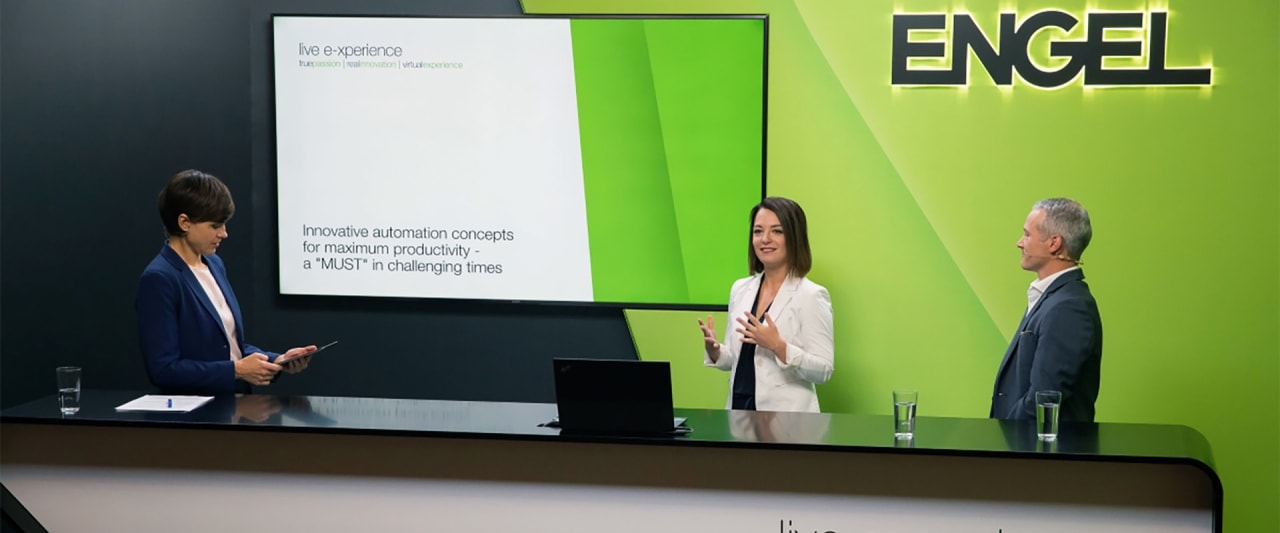
At the live e-symposium 2021, ENGEL is connecting two major trends that are shaping our industry: digitalisation and sustainability. As Dr. Stefan Engleder, CEO of the ENGEL Group, emphasized during his opening keynote, “What we need is a change in the mindset. We have a broad spectrum of mature digital solutions at our disposal. Now it’s a matter of leveraging this to operate injection moulding production with a view to sustainability.”
This isn’t just talk—ENGEL is taking a holistic approach by examining the entire product lifecycle from design and production through to recycling, a perspective that was clearly demonstrated throughout the e-symposium.
Sustainability isn’t just another industry buzzword. The requirements for sustainable injection moulding production are certainly challenging, but they’re absolutely achievable with the right technological approach. And this is where digitalisation opens doors to possibilities that simply weren’t available before.
Reducing CO₂ Emissions Through Digitalisation
“Digitalisation helps us to leverage the full potential of the injection moulding machine, and to make production more efficient by doing so,” explains Stefan Engleder.
The numbers back this up. A recent study by Accenture for bitkom projects that digitalisation could slash current CO₂ emissions from German companies by up to 58 percent. Manufacturing—which accounts for 23 percent of this potential reduction—stands to benefit enormously.
“If we genuinely make use of digitalisation,” Engleder points out, “the CO₂ reduction targets set by politicians will suddenly no longer seem impossible.”
Let’s look at a real-world example: the production of door components for vehicle interiors. ENGEL’s sim link technology creates a bridge between simulation and physical production, allowing manufacturers to:
- Transfer process settings determined in simulation directly to the injection moulding machine
- Significantly accelerate mould sampling
- Further optimize processing parameters
- Send machine parameters and measurement results back to simulation
“The mould filling study already gives us the correct setting parameters for the machine without having to intervene manually,” explains Dr. Gerhard Dimmler, Vice President of Research & Development at ENGEL. “The match between the mould filling simulation and the physical filling study is impressive.”
Once production is running, smart assistance systems like iQ weight control and iQ flow control prevent rejects and significantly reduce energy consumption—a win for both your bottom line and environmental footprint.
Horizontal Platforms to Establish Recycling and Upcycling
ENGEL now approaches the product lifecycle in four key phases that are critical for plastics processors: design, sampling, production, and maintenance/service.
The pandemic has pushed digitalisation and networking in maintenance and service to the forefront. Manufacturers are increasingly asking: How can we ensure productivity and delivery capacity during future crises? Digital service solutions—particularly remote maintenance and online support—provide essential answers.
“Numerous newly installed injection moulding machines are already online, and more are coming online all the time,” Dimmler notes. “The increasing number of digital applications will automatically cause machine connectivity to increase.”
Currently, many digital applications like ENGEL’s e-connect.24 for remote maintenance are implemented as vertical solutions within ENGEL’s e-connect customer portal. These “vertical” solutions create a digital twin of a system within a single stage of the value chain, laying groundwork for optimization.
But the industry is evolving. ENGEL and other plastics industry leaders are now moving toward horizontal platforms that connect the entire value chain—and this shift is proving crucial for circular economy initiatives.
“Our goal is to replace the downcycling of materials that has been prevalent thus far with recycling or even upcycling,” says Engleder. “This only works if data is shared across the entire product lifecycle, that is, along the value chain.”
Consider digital watermarking on packaging—an invisible marker that identifies material type, manufacturer information, and processing method. When this data is available to all participants in a horizontal platform, recycling processes can be precisely controlled for maximum resource efficiency, resulting in higher-quality recycled materials.
Well Prepared for New Challenges
At LIT Factory—the teaching, learning and research facility for smart polymer processing at Johannes Kepler University in Linz, Austria—ENGEL collaborates with companies from across the plastics industry to explore horizontal networking opportunities. These partnerships are developing new processes, products, and business models with circular economy principles at their core.
“We are looking to be well prepared for the challenges of sustainability, because we are convinced that digitalisation and platform solutions are important keys to greater sustainability and to building up a circular economy,” emphasizes Engleder.
The message from ENGEL’s leadership at the e-symposium was clear: now is the time for plastics processors to embrace digital solutions and participate in horizontal platforms. As Stefan Engleder put it, “Together, we are shaping a sustainable plastics industry.”
This shift doesn’t just benefit the environment—it creates new business opportunities, improves efficiency, and positions forward-thinking manufacturers at the cutting edge of industry innovation. The future of injection molding isn’t just digital or sustainable—it’s both, working in harmony.