Maximize Production in Minimal Space: High-Speed Molding
Maximize productivity with the compact Engel duo speed injection molding machine. Discover how this two-platen innovation is transforming packaging production.
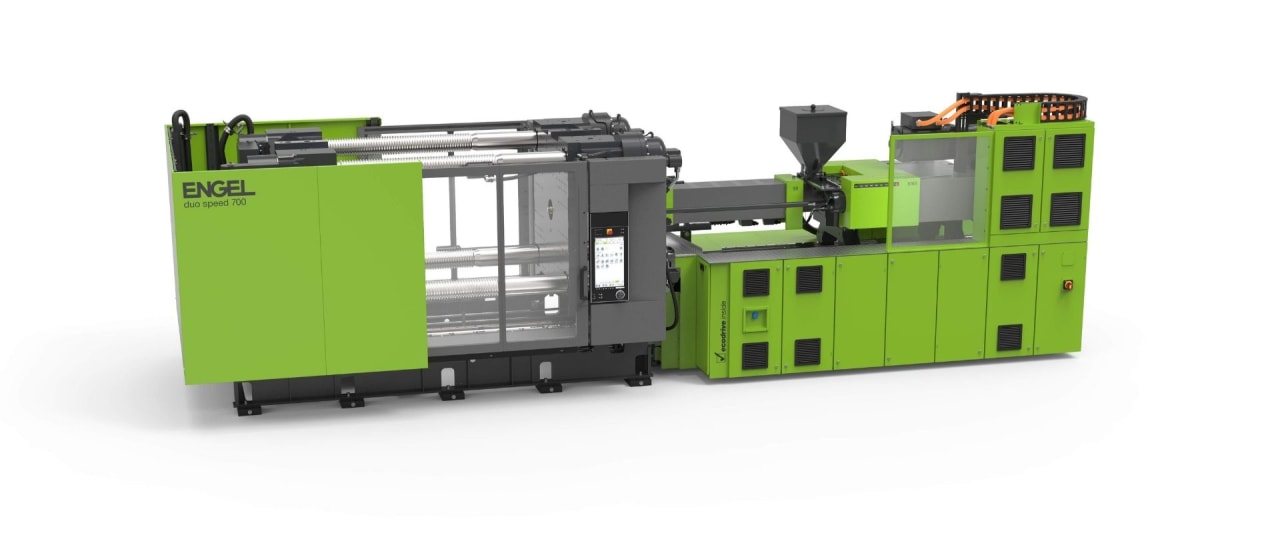
Engel Duo Speed: High-Speed Machine with a Small Footprint
Engel Duo Speed Expands the Machine Portfolio for Packaging
The new Engel duo speed injection-molding machine brilliantly combines productivity and efficiency with impressively short cycle times in the high clamping force range. This innovative two-platen machine is making significant inroads into packaging applications that were traditionally dominated by toggle machines. Available with clamping forces from 4000 to 11,000kN, the duo speed is primarily designed for manufacturers of pails, storage containers, and transport containers.
Two-platen injection molding machines have always offered the advantage of a compact footprint, leading to higher overall efficiency in many applications. However, until now, this machine type reached its limits when dealing with the very short cycle times typical in packaging applications. While a toggle system needs just a single drive axis for closing the mold and building up clamping force, a two-platen machine requires three individual movements: rapid closing, locking movement, and clamping-force build-up. This typically involves eight hydraulic cylinders whose switching and transition times extend the cycle time.
Thanks to Engel’s continuous enhancement of its two-platen technology, they’ve successfully broken the 2-second barrier for dry cycle time. The new duo speed injection machine now allows manufacturers to combine short cycle times with a small footprint, even in cost-sensitive packaging applications.
Over 25 Years of Experience with Two Platens
The duo speed is built on the proven platform of Engel’s two-platen large duo machine, which has an impressive 25-year track record in the industry. It’s one of the fastest two-platen injection molding machines available today, explaining its tremendous success in automotive, telecommunications, electronics, and white goods manufacturing.
To extend the machine’s application range, both the moving and stationary platens have been precisely adapted to meet packaging producers’ specific requirements. The result? A reduction in dry cycle time by up to 25%. According to Euromap 6 standards, the duo speed 400 (with 4000kN clamping force) achieves a remarkable dry cycle time of just 1.9 seconds. Even the largest available model—the duo speed 1100 with 11,000kN clamping force—stands among the fastest machines in its market segment with a dry cycle time of only 2.9 seconds.
Predictive Movement Sequences Shorten the Cycle
To minimize dry cycle time, Engel’s engineers focused intensively on optimizing individual movement sequences, including mold closing, locking, and clamping-force build-up. The key innovation here is Engel’s patented predictive movement control, which allows movement sequences to overlap seamlessly. This means the cycle-time critical locking process now occurs completely in parallel with rapid movement and clamping-force build-up. Additionally, the smooth transition from rapid movement to clamping-force build-up further shortens the overall time needed, while creating smoother machine operation.
Using predictive movement control along with other optimizations, Engel has also shortened the clamping-force reduction sequence. While clamping force is typically reduced during cooling time (when the mold remains closed anyway), applications with short cycle times require maintaining clamping force as long as possible—something only achievable when the clamping-force reduction phase is extremely short without extending cycle time.
The duo speed’s short dry cycle times also benefit from improved opening and closing movements, which saves valuable time especially with the large opening strokes needed for pail production and stack molds. From the beginning, Engel developed the duo speed with multicavity molds in mind, accounting for their greater demands on clamping force distribution. The mold-mounting platens were optimized using FEM simulations to ensure uniform clamping force distribution across the entire mold mounting area, guaranteeing consistent, high-quality parts.
Smart Pump Control Improves Energy Efficiency
In the packaging industry, cycle time directly determines production efficiency and ultimately a manufacturer’s competitiveness. However, product quality remains equally critical. Stability and smooth machine operation are essential quality requirements. For this reason, the drive system for the moving mold half doesn’t use hydraulic accumulators (typical in packaging machines) but instead employs a smart pump control.
Combined with the proportional valve at the moving mold half, this pump control allows for optimized movement sequences tailored to specific parameters. The result is an excellent balance between speed and smooth operation. The system provides only the pressure actually required, which—along with the ecodrive servohydraulics—contributes significantly to the machine’s impressive energy efficiency. Compared to accumulator operation, energy consumption for closing and opening movements is reduced by half, with overall energy consumption approximately 20% lower.
This approach also reduces wear on mechanical components. Over 25 years of experience with these machines has enabled Engel to create an exceptionally robust design with outstanding availability.
Unlimited Possibilities Also at the Injection Unit
A key innovation in the injection unit is the speed unit—originally developed for Engel’s e-speed series. This unit is specifically designed for applications requiring high dynamics and exceptionally high injection speeds, even with relatively large screw diameters. This unit series is now optionally available for the duo speed as well. Compared to the standard injection unit, the high-speed unit delivers twice the injection speed—up to an impressive 800 mm/s—enabling shorter cycle times for applications with demanding dynamic requirements. Despite trends toward reduced wall thicknesses and longer flow paths, there are no longer limitations at the injection unit. The unit operates with accumulators that charge automatically on demand, saving 5-10% energy compared to conventional solutions.
For plasticizing—a particularly energy-intensive process—an electrical screw drive provides high efficiency. The plasticizing unit operates independently of hydraulic movements like mold opening and closing. The duo speed comes equipped with a barrier screw and ring-check valve optimized for PP and PE-HD, with specialized screw drives for these materials available as options.
Larger Opening Strokes Create More Freedom
The duo speed’s small footprint not only refers to its energy-efficient operation but should be taken quite literally. These two-platen machines are significantly shorter than toggle machines of comparable clamping force—while offering larger maximum opening strokes. The stroke is limited only by tie-bar length, not a toggle mechanism. These larger opening strokes benefit both large molds (like those used for large pails) and automation systems for demolding parts.
Engel provides complete integrated system solutions comprising both injection molding machines and robots. For manufacturing pails and transport boxes, linear robots from the viper series are typically employed. The integrated solution offers advantages like unified control systems with consistent operating logic and CE certification for the entire system. Since machine and robot access the same database, they can precisely coordinate their movement sequences, shortening handling times.
Equipped for Recyclates
Sustainability has become a central focus in the packaging industry. As a comprehensive system supplier, Engel can configure the duo speed for recyclate processing at the customer’s request. Process technologies for manufacturing multilayer and multicomponent products—such as coinjection or Engel’s newly developed skinmelt process—enable increased use of reprocessed plastic waste in manufacturing parts with demanding requirements for surface quality, product protection, or consumer safety.
At Engel’s large machine plant in St. Valentin, Austria, the new injection molding machine is available for customer testing, along with machines featuring coinjection and skinmelt technology packages. Engel’s application technology team supports packaging producers in optimizing their injection molding machines for specific product requirements and industrial conditions, minimizing cycle times while maintaining consistently high part quality.
By expanding its portfolio, Engel now offers ideal solutions across the spectrum—from thin-walled packaging to closures to thick-walled large containers. While the duo speed is engineered for large-volume and long parts, the e-speed covers thin-wall applications with very short cooling and cycle times. The e-cap, meanwhile, targets the specific requirements of manufacturing various closure types for the packaging industry.
With the introduction of the duo speed, packaging manufacturers now have access to an exceptional machine that combines the benefits of two-platen technology with the speed and efficiency needed in today’s competitive market.